The cheapest catering service is the one that needs the fewest people standing behind it. Ingredient cost per guest varies less than most families expect. What moves a quote up or down is the service format: how many staff the food needs, how much equipment has to be carried into the venue, and how much floor space and power the setup takes once it is there.
These are the ten catering service formats we run in Lucknow, grouped by what each one demands rather than by a price band. Read it as a menu of formats, not a league table of companies. Any of the ten can be done well on a sensible budget. The expensive mistake is paying for a format your event did not need.
What actually decides the cost
Four things, in roughly this order of weight.
- Staff per guest. A buffet is served by a small team standing behind counters, and that team barely grows as the guest list does. Plated service puts a steward in charge of a handful of tables, so the same guest list can multiply the service team several times over.
- Equipment that has to travel. A tandoor, a chaat counter, a live pasta station and a dessert freezer each arrive on a vehicle, get carried in, get set up and get carried out again. Formats built on machinery cost more than formats built on warmers.
- Floor space and power. Counters occupy space the venue is already charging you for, and several of them need a power point that will hold up for four hours.
- Hours on site. A counter running from eight until midnight is a cook and an assistant paid for the evening, whether twenty guests use it or two hundred.
None of that is visible on a per-plate figure, which is why two quotes for the same dish list can land far apart. Our guide to what wedding catering costs in Lucknow covers the arithmetic. This article covers the choice sitting underneath it.
Three formats that stretch a modest budget
These serve the most people for the least service overhead. None of them is a compromise on food. They are a compromise on ceremony.
1. Buffet style dinner
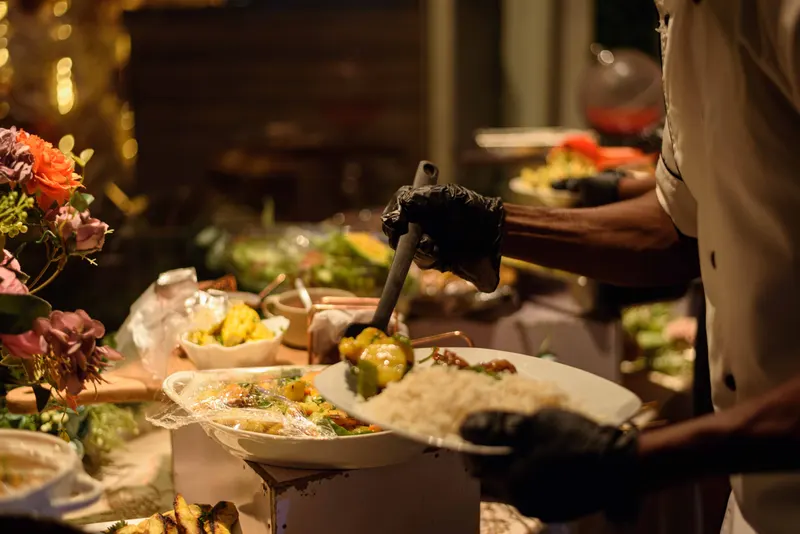
Stationary counters, guests served across the line, staff working behind it to keep the food stocked and hot. It is the most efficient way to feed a large wedding crowd in Lucknow, and the reason it stays standard is arithmetic rather than laziness. Spend the saving on better dishes, not on more of them.
2. Stationary presentation station
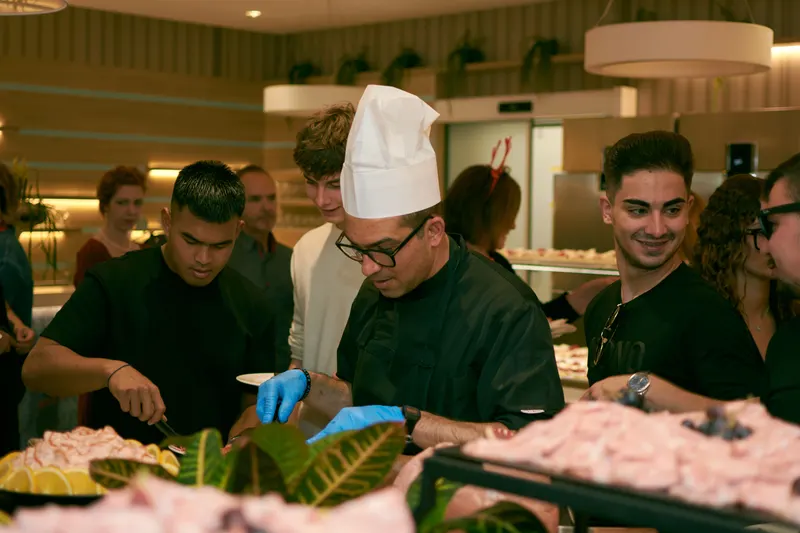
One well-built central display doing the work three scattered counters would otherwise do. It reads as generous, takes a fraction of the floor space, and gives the photographer a single strong setting. Useful when the venue is tight and the guest list is not.
3. Traditional Indian service
Pre-plated entrees, sandwiches and salads brought out on a rolling cart display, in the pattern most Lucknow families already know from home functions. Portioning happens in the kitchen rather than at the counter, which controls waste and keeps queues short.
The single most useful budget decision: pick the service format first, then build the menu inside it. Families who choose dishes first almost always end up paying to force an oversized menu through a format that was never designed to carry it.
Four formats worth the middle of a budget
Each of these adds a cook, a machine or a specialist brief. They earn their cost when guests notice them, and waste it when they are ordered by default.
4. Chef stations and live counters
Food finished in front of the guest: chaat, tandoor, dosa, pasta, grills. A live counter is the strongest single upgrade available to a mid-range event, because it turns a queue into something worth standing in. It is also the easiest line item to overbuy. We wrote a whole piece on which live counters earn their space, and the short version is that three good ones beat six thin ones.
5. Dietary and allium-free menus
Jain and no-onion-no-garlic cooking, plus keto, low-carb and detox menus for guests who need them. The cost is not exotic ingredients, it is separation: a parallel prep line, separate serving equipment, and staff briefed to keep the two apart. Planned in at booking it is a modest addition. Requested on the day it is not deliverable at all.
6. Specialised world-cuisine menu
Continental, Italian, Middle Eastern or pan-Asian sections built alongside the Awadhi core. Worth the money when a real part of the guest list will eat from them, which at most Lucknow weddings means a younger crowd and out-of-town guests. One section executed properly beats four token ones.
7. Welcome drinks and mocktail counters
The cheapest way to make an arrival feel handled. A mocktail counter fills the gap between guests arriving and dinner opening, which is the stretch of the evening families most often leave empty. It needs glassware, ice and one person, and it changes the mood of the first hour.
Three formats that cost the most
All three replace counters with people. They are the right answer for smaller, seated, slower events, and the wrong answer for a large wedding crowd that wants to eat and get back to the music.
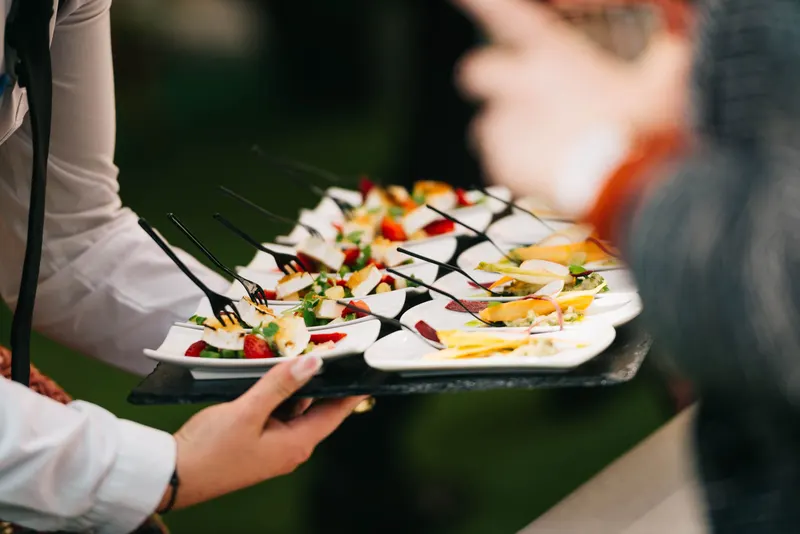
8. Mini plate samplers
Small portions carried through the room on trays. Guests never queue, which is the point, but every tray needs a person and the room needs enough of them that food reaches the far corners while it is still hot. Best used for the starter hour rather than the whole meal.
9. Platter service
An upscale version of the same idea: composed platters presented to each table or group rather than single bites offered around. Slower, more formal, and it shows off plating in a way a buffet cannot.
10. Deluxe plated service and the dining journey
Fully seated dinner, courses served to the table by trained stewards, timed as a sequence rather than opened all at once. This is the most staff-intensive format we run and the most controlled: every guest gets the same dish at the same temperature at the same moment. It needs a fixed seating plan, a confirmed headcount, and a guest list that will stay in its seats.
Matching a format to your event
A rough mapping, based on what we are asked for most often.
- Large wedding, 400 guests and up: buffet as the spine, two or three live counters, welcome drinks on arrival.
- Reception or sangeet, 150 to 300: buffet plus tray-passed starters while guests arrive, and one signature counter.
- Corporate lunch or conference, 50 to 150: a stationary presentation station or a compact buffet, because the real constraint is the clock. See corporate catering.
- Family gathering or milestone dinner, under 60: plated or platter service becomes genuinely affordable at this size, and it makes a small room feel like an occasion.
- Farmhouse or destination wedding: whatever the format, budget for the fact that everything arrives by vehicle and nothing is available locally at short notice.
Where catering budgets get wasted
Five patterns we see repeatedly, in rough order of how much money they cost.
- Too many dishes. The most expensive habit in Lucknow wedding catering, and the one that hurts food quality as well as budget. Read how many dishes a wedding menu should actually have.
- Too many live counters. Every unused counter is a cook, a machine and a patch of floor paid for and not used.
- Premium service for a standing crowd. Plated service at an event where guests will not stay seated buys you nothing at all.
- Paying twice for equipment. Ask the venue what it already provides in crockery, linen and warmers before the caterer quotes to bring it.
- An unconfirmed headcount. Cooking for a number nobody committed to means either waste or shortage, and both get paid for. Our catering checklist covers what to settle and when.
If you would rather have this applied to your own event than read in the abstract, tell us the date, the venue and a working guest count, and we will suggest the format before we suggest a menu. Get a menu and quote, or read the full list of service styles we run.
Questions we get asked
Which catering service is cheapest for a large guest count?
A stationary buffet, almost always. It serves the most people from the fewest staff and the least equipment, and it scales without the cost rising in steps. Every other format adds either people, machinery or floor space per guest, which is what makes it more expensive to run.
Can we mix catering service styles at one event?
Yes, and most well-planned events do. A common pattern is tray-passed starters and welcome drinks while guests arrive, one or two live counters through the evening, and a buffet for the main course. Mixing lets you spend on the parts guests remember and stay efficient everywhere else.
Does a smaller guest count mean a cheaper catering service?
The total falls, but the cost per guest usually rises. A counter needs the same cook whether it feeds eighty people or two hundred, and transport, setup and equipment do not shrink with the guest list. Small events are where premium formats such as plated service become affordable, because the staffing is spread over fewer covers.
How far ahead should we book catering in Lucknow?
For a wedding date in the November to February season, three to four months ahead is comfortable and popular dates go earlier than that. For a corporate lunch or a family gathering outside the season, two to three weeks is usually enough. Book earlier if your event needs several live counters, because the constraint is trained cooks, not kitchen capacity.

Anil Caterers, Lucknow
Catering weddings, corporate events and private parties across Lucknow since 2000, under founder and executive chef Anil Gupta. More about the kitchen.